Mitsubishi Engines for Sale GET A QUOTE →

MITSUBISHI ENGINE GUIDE · UK

Mitsubishi L200 Replacement Engines

Compare Mitsubishi L200 4D56, 4N14 and 4N15 replacement engines, model years, technical specifications, common diagnosis points, prices and used or reconditioned options.

Quick answer

For UK Mitsubishi L200 owners, garages and mechanics comparing replacement-engine options, this page currently covers 4D56, 4N14, 4N15 in 2.5L, 2.3L, 2.4L Diesel applications across the covered 2014–2021 model years.

ENGINE SIZE2.5L / 2.3L FUELDiesel OPTIONSUsed · Recon · Fitted
Mitsubishi L200 replacement engine model
ENGINE MATCHReg + code + derivative
FASTEST ROUTE

Find the correct Mitsubishi engine

Enter the UK registration and we will identify the vehicle before opening the quote form.

OR
NO REGISTRATION?

Choose your Mitsubishi manually

Select model, engine size, fuel type and engine code from the compatibility matrix.

MITSUBISHI L200 ENGINE ANSWER

Which replacement engines are recorded for the Mitsubishi L200?

Short answer: The current verified compatibility data for the Mitsubishi L200 records 4D56, 4N14, 4N15 across 2.5L Diesel, 2.3L Diesel, 2.4L Diesel for the covered 2014–2021 applications. The sections below separate technical specification, known diagnosis points, replacement condition and source evidence so the page answers more than a simple fitment question.

MODELL200
ENGINE CODES4D56 · 4N14 · 4N15
ENGINE SIZES2.5L · 2.3L · 2.4L
FUELDiesel
FIRST-PARTY DATA SNAPSHOT 4 compatibility records

This page is generated from the Mitsubishi compatibility data currently stored for L200, covering 3 specified engine codes and 3 recorded size/fuel routes.

PRICE DATA 3 exact-code prices

Reference prices are shown only where the site's current price table contains a value for the exact engine code.

OWNERSHIP & REVIEW Published by Mitsubishi Engines for Sale

Reviewed by Mitsubishi Engines for Sale technical content team. Last reviewed 25 September 2026.

MODEL ENGINE MATRIX

Engines recorded for the Mitsubishi L200

4
YearsEngine codeSizeFuelVariant
2014 4D56 2.5L Diesel —
2019-2021 4N14 2.3L Diesel —
2020 4N14 2.3L Diesel —
2015-2020 4N15 2.4L Diesel —
TECHNICAL ENGINE DATA

Mitsubishi L200 engine specifications, outputs and applications

Technical values are shown by engine code so capacity, family, timing system and output are visible without repeating the same matching disclaimer.

ENGINE CODE 4D56
£1,995

Mitsubishi 4D56 2.5 diesel

The 4D56 is a long-running four-cylinder diesel family used in Mitsubishi utility and 4x4 applications. Early and later derivatives differ substantially in injection, turbo and cylinder-head specification.

Size
2.5L
Fuel
Diesel
Years on this model
2014
Engine family
4D5
Timing system
Timing belt
Aspiration
Naturally aspirated or turbocharged
Power
74–178 BHP
Torque
142–400 Nm
MANUFACTURER APPLICATIONS

L200; Shogun; Shogun Sport; Delica

ENGINE CODE 4N14
£1,300

Mitsubishi 4N14 2.3 DI-D

The 4N14 is a 2.3-litre common-rail turbo-diesel used strongly in Outlander and ASX applications, with output and emissions hardware varying by derivative.

Size
2.3L
Fuel
Diesel
Years on this model
2019–2021
Engine family
4N1
Timing system
Timing chain
Aspiration
Turbocharged
Power
148–177 BHP
Torque
360–380 Nm
MANUFACTURER APPLICATIONS

Outlander; ASX

ENGINE CODE 4N15
£3,800

Mitsubishi 4N15 2.4 DI-D

The 4N15 is a long-stroke 2.4-litre common-rail turbo-diesel used in later L200 and Shogun Sport applications. It is a different engine family from the 4D56.

Size
2.4L
Fuel
Diesel
Years on this model
2015–2020
Engine family
4N1
Timing system
Timing chain
Aspiration
Turbocharged
Power
150–181 BHP
Torque
380–430 Nm
MANUFACTURER APPLICATIONS

L200; Shogun Sport

COMMON PROBLEMS & DIAGNOSIS

Engine problems and diagnosis points for the Mitsubishi L200

Items marked “documented issue” come from the technical content dataset. “Diagnosis point” means the component or symptom should be checked before concluding that the complete engine has failed.

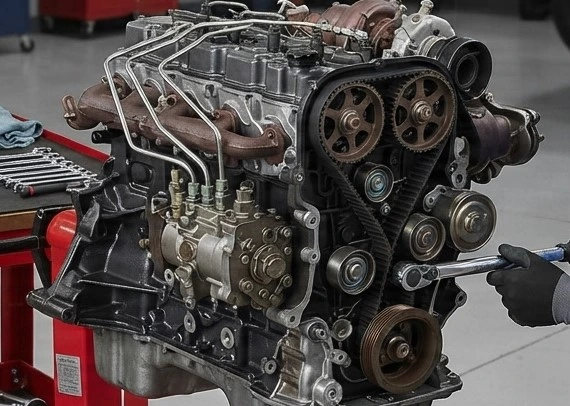
Mitsubishi 4D56 engine reference image 4D56

Mitsubishi 4D56 problems & checks

DOCUMENTED ISSUE

Timing-belt or balance-shaft belt deterioration

The belt-driven valve train requires correct service history and installation. Belt failure can cause internal contact and major damage.

Possible signs: Non-start; abnormal noise; loss of compression Why it matters: Confirm belt, tensioner and pulley condition and establish whether internal contact occurred before deciding on a complete engine.
DOCUMENTED ISSUE

Overheating and cylinder-head damage

Sustained overheating can distort or crack the cylinder head and can damage the head gasket.

Possible signs: Coolant loss; pressurised hoses; white smoke; overheating Why it matters: Repair the cooling-system cause as part of any engine repair or replacement.
DIAGNOSIS POINT

Turbocharger wear / boost fault

Smoke, boost loss or oil consumption can originate in turbo hardware rather than the long engine.

Possible signs: Smoke; low boost; turbo noise; oil consumption Why it matters: Inspect turbocharger, oil feed/return and boost system separately before condemning the base engine.
DIAGNOSIS POINT

Injector / fuel-system fault

Fuel-system or injector problems can create hard starting, smoke and poor running, particularly on later common-rail derivatives.

Possible signs: Hard start; smoke; uneven running; poor performance Why it matters: Check fuel pressure and injector operation before treating the symptoms as proof of engine failure.
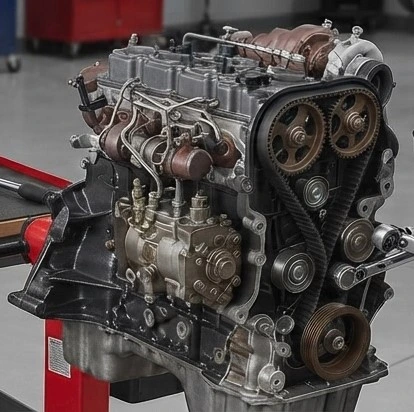
Mitsubishi 4N14 engine reference image 4N14

Mitsubishi 4N14 problems & checks

DOCUMENTED ISSUE

DPF and EGR related running problems

Short-trip use, failed regeneration or EGR contamination can cause warning lights and restricted performance.

Possible signs: Warning lamp; limp mode; increased fuel use; poor performance Why it matters: DPF or EGR faults are not evidence of base-engine failure; diagnose the emissions system first.
DIAGNOSIS POINT

Boost pressure / turbocharger fault

Low boost can originate in turbocharger control, intake leaks or sensor faults.

Possible signs: Low power; limp mode; boost fault codes Why it matters: Separate boost-system diagnosis from base-engine condition.
DIAGNOSIS POINT

Injector / sensor fault

Common-rail and engine-management faults can cause rough running or poor performance.

Possible signs: Hard start; uneven running; warning lamps Why it matters: Check injectors, rail pressure and relevant sensors before deciding on engine replacement.
Mitsubishi 4N15 engine reference image 4N15

Mitsubishi 4N15 problems & checks

DOCUMENTED ISSUE

Oil dilution or incorrect oil condition

Diesel regeneration strategy and service history can affect oil condition. Excess level or degraded oil requires investigation.

Possible signs: Rising oil level; oil warning; abnormal engine noise Why it matters: Find the cause of the oil-condition change; a routine oil concern does not automatically require engine replacement.
DIAGNOSIS POINT

DPF / EGR restriction

Emissions-system restriction can create warning lights or reduced performance without proving internal engine failure.

Possible signs: Warning lamp; limp mode; poor performance Why it matters: Check regeneration history, EGR operation, sensors and after-treatment before condemning the long engine.
DIAGNOSIS POINT

Injector / fuel-delivery fault

Common-rail injector or fuel-delivery faults can overlap with mechanical engine symptoms.

Possible signs: Hard start; smoke; uneven running; knock Why it matters: Fuel-pressure and injector diagnosis can prevent unnecessary complete-engine replacement.
DIAGNOSIS POINT

Timing-area noise

The 4N15 uses a timing chain, so persistent timing-area noise should be investigated together with oil condition and service history.

Possible signs: Rattle or abnormal timing-area noise Why it matters: This is a diagnosis point rather than a claim that every 4N15 develops chain failure.
DIRECT ENGINE COMPARISON

Compare Mitsubishi L200 engine codes side by side

Use this table to compare the factual differences between the engine families currently recorded for this model.

Engine code Years Size / fuel Family Timing Power Torque Reference price
4D56 2014 2.5L Diesel 4D5 Timing belt 74–178 BHP 142–400 Nm £1,995
4N14 2019–2021 2.3L Diesel 4N1 Timing chain 148–177 BHP 360–380 Nm £1,300
4N15 2015–2020 2.4L Diesel 4N1 Timing chain 150–181 BHP 380–430 Nm £3,800
EARLIER DIESEL FAMILY4D562.5L · Timing belt · 74–178 BHP
VS
LATER DIESEL FAMILY4N152.4L · Timing chain · 150–181 BHP

The 4D56 and 4N15 are different engine families. Capacity, timing drive, fuel/emissions hardware and installation specification differ, so they should not be treated as direct substitutes.

USED VS RECONDITIONED

Used vs reconditioned Mitsubishi L200 engines

Compare what the condition labels actually mean before comparing the headline price.

USED ENGINE

Previously operated engine

A used engine is supplied in its available used condition. Useful evidence can include donor details, mileage where available, test information, photographs, included ancillaries and written warranty terms.

  • Ask what was tested before dispatch.
  • Check which ancillaries are included.
  • Compare mileage/test evidence and warranty.
RECONDITIONED ENGINE

Inspection and refurbishment scope

A reconditioned engine has undergone inspection and refurbishment, but the exact machining and replacement parts depend on the supplier. The written rebuild scope is therefore more useful than the label alone.

  • Ask which internal parts were renewed.
  • Ask what machining and measurements were completed.
  • Compare testing, fitting requirements and warranty.
TECHNICAL REFERENCES & E-E-A-T

Source evidence for Mitsubishi L200 engine information

Compatibility rows come from the site's verified Mitsubishi dataset. Technical specifications are separated from supplier-specific engine condition, while manufacturer references are provided for model and engine context.

ENGINE IDENTIFICATION IMAGES

Compare the physical engine, not only the rounded capacity

Useful evidence includes a full donor-engine photograph and a clear image of the engine-code or identification marking. Connectors, manifolds, turbo/injection hardware, sump and major ancillaries can also help distinguish derivatives.

Mitsubishi 4D56 engine identification reference image
4D56 reference engine
Mitsubishi 4N14 engine identification reference image
4N14 reference engine
Mitsubishi 4N15 engine identification reference image
4N15 reference engine
MITSUBISHI ENGINE INFORMATION

What you need to know before choosing a replacement engine

Mitsubishi L200 supply only or supply and fit

Choose a scope that states exactly what is included

A supply-only quote should state the exact engine, condition, included ancillaries, delivery terms and warranty. A fitted quote should additionally state removal, installation, fluids, filters, diagnostics, commissioning and the treatment of transferred turbo, fuel-system, clutch/torque-converter and emissions components where relevant.

Mitsubishi L200 engine warranty information

Warranty terms depend on engine condition and supplier

Warranty depends on the supplier, engine condition and installation terms. Compare the written cover for parts, any labour contribution, overheating or oil-starvation exclusions, transferred ancillaries, required servicing and claim authorisation. Keep the invoice and fitting/service evidence required by the chosen supplier.

QUESTIONS & ANSWERS

L200 engine FAQs

Technical and buying questions are answered from the model data, engine specifications, diagnosis notes and supplier-scope guidance used across this Mitsubishi engine site.

Which engine codes are covered for the Mitsubishi L200?+

Answer: The current site data records 4D56 2.5 diesel for 2014, 4N14 2.3 diesel across covered 2019-2021 applications and 4N15 2.4 diesel across covered 2015-2020 applications.

What is the difference between the L200 4D56 and 4N15 engines?+

Answer: The 4D56 is a 2.5-litre 4D5-family diesel using a timing belt, while the 4N15 is a later 2.4-litre 4N1-family common-rail turbo-diesel using a timing chain. They are different engine families rather than direct substitutes.

What problems are documented for the 4D56?+

Answer: The technical dataset documents timing-belt or balance-shaft belt deterioration and overheating that can damage the cylinder head or head gasket. Turbo and injector faults are separate diagnosis routes rather than automatic proof of long-engine failure.

What problems are documented for the 4N15?+

Answer: The dataset documents oil dilution or incorrect oil condition as a 4N15 concern. DPF/EGR restriction, injector faults and timing-area noise are also useful diagnosis points before a complete replacement decision.

Used or reconditioned L200 engine: what should I compare?+

Answer: For used engines compare condition, donor/test evidence, ancillaries and warranty. For reconditioned units compare the documented machining, measurements, replaced parts, testing and warranty.

Can an L200 engine be supplied and fitted?+

Answer: Supply-only and fitted quotations can be compared where available. A fitted quote should state removal, installation, fluids, diagnostics, commissioning and the treatment of existing ancillaries.

READY TO COMPARE?

Get Mitsubishi engine quotes matched to your vehicle

Use the registration or manual engine selector so suppliers receive the right model, size and engine-code context.

Start with my vehicle →